
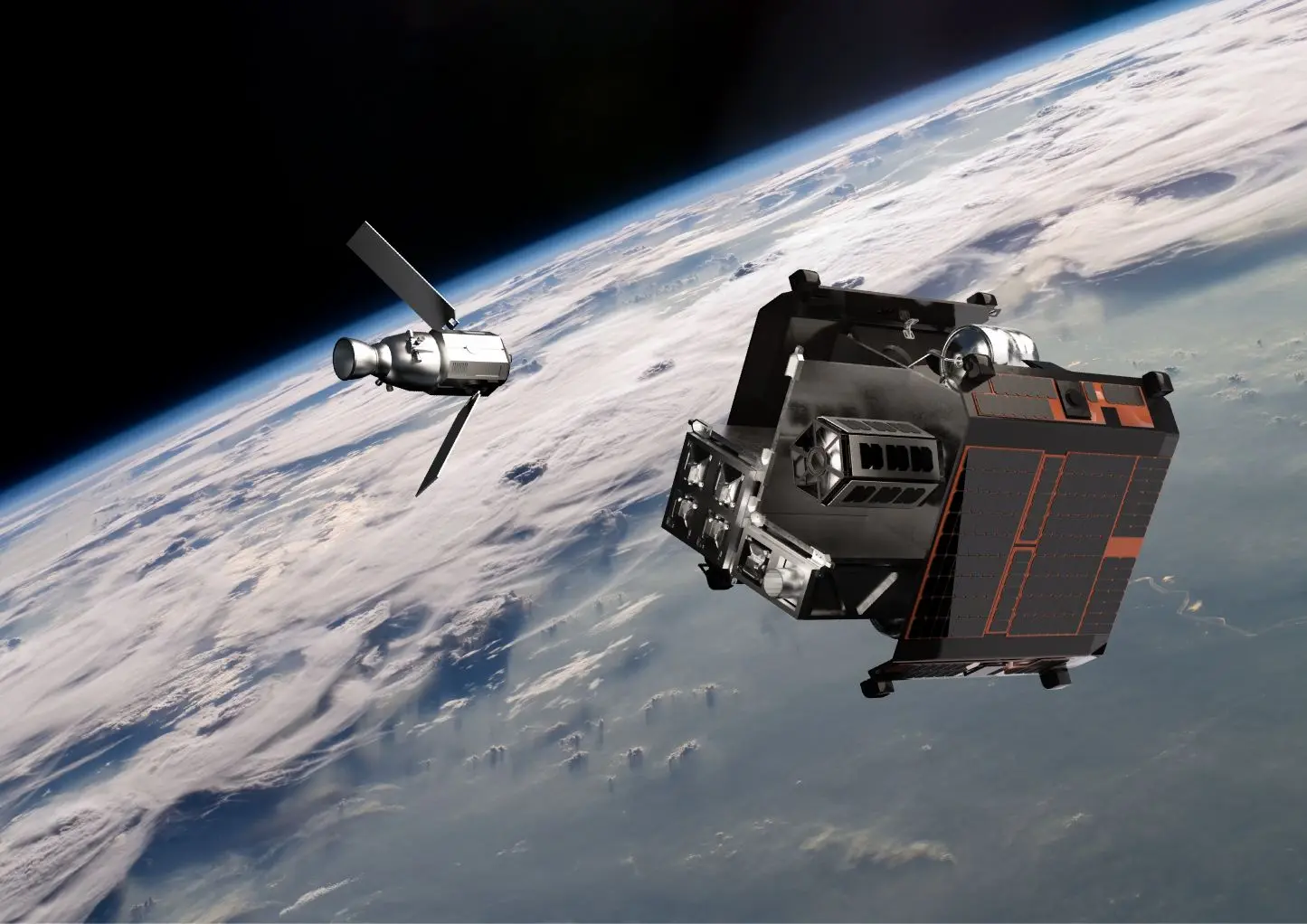
An Italian take on an “Amazon for space.” Founded in 2011 by Luca Rossettini and Luca Panesi, D-Orbit is now one of the most advanced players in the space logistics sector. Based in Fino Mornasco, near Como, the company was built on an early intuition: the future of the space economy would be driven by constellations of small satellites.
Long before the sector became mainstream, D-Orbit developed an infrastructure capable of managing orbital transportation, in-space data processing, and satellite servicing. Speaking with Infra Journal, co-founder Luca Panesi retraces the origins of the company, the milestones behind D-Orbit’s international growth, and the technological and industrial challenges shaping the new space economy — from orbital sustainability to the digital infrastructure of the future.
How was D-Orbit founded, and why? What roles did you and Luca Rossettini play?
“D-Orbit was founded in 2011 from a project Luca Rossettini and I developed during a Fulbright-funded experience in Silicon Valley. We realized the space industry was changing: the future would no longer revolve around a handful of large satellites, but around constellations of smaller, cheaper, and more flexible ones.
That model required entirely new logistics services: orbital management, satellite deployment, and end-of-life disposal. Rather than competing with constellation operators, we chose to build the infrastructure supporting them. Our initial focus was satellite decommissioning — which is also where the name D-Orbit comes from.”
Did you see yourselves as pioneers in Italy?
“Yes. Back in 2011, Italy’s new space ecosystem was virtually nonexistent: there was very little investment, very few startups, and the sector was still highly traditional. During the early years, we built the company by collaborating with ESA and ASI and by participating in European programs such as Horizon 2020.
We even built our own clean rooms and mission control center in-house to keep costs down. What began as a necessity eventually became a competitive advantage.”
What was the original vision?
“While in Silicon Valley, we witnessed the emergence of the first large satellite constellation projects. In what looked like a gold rush, we wanted to ‘sell shovels and pickaxes’ — in other words, create the orbital logistics layer.
The idea was to develop vehicles capable of transporting satellites, deploying them into the correct orbits, hosting experiments, and eventually repairing or recovering them. At the time, it sounded like science fiction. Today, it’s an operational business.”
What have been the key milestones in D-Orbit’s growth?
“The first turning point was our initial funding round, which allowed us to develop the technology and expand the team. In 2017, we launched D-Sat, the first satellite entirely designed and operated by D-Orbit — a crucial step in building expertise in propulsion systems and autonomous operations.
That led to the creation of ION Satellite Carrier, launched in 2020 and immediately turned into a commercial service. To date, it has completed 22 missions and delivered more than 210 payloads into orbit.
Then came two major developments in 2024: a €119 million ESA contract for the RISE mission and a €150 million capital increase. Finally, in 2025, the integration with Planetek opened the door to the satellite data sector.
The toughest challenge was surviving the early years, when the orbital logistics market simply didn’t exist yet.”
How is D-Orbit structured today?
“Today, our activities are organized around four main areas.
The first is orbital logistics, through ION Satellite Carrier, which transports satellites and hosts payloads. The second is Space Cloud Services, enabling data processing directly in orbit. The third is in-orbit servicing: repairing, refueling, or repositioning satellites through the GEA platform developed for the RISE mission.
The fourth area, created through the integration with Planetek, focuses on geospatial intelligence services powered by satellite data.
In recent years, the strongest growth has come from the continuity of ION missions and our entry into the orbital servicing market.”
What sets you apart from international competitors?
“Our main advantage is the experience we’ve accumulated. We started working on orbital logistics earlier than many others, which means years of testing and real-world missions.
Today we can offer a fully integrated infrastructure: orbital transportation, payload hosting, in-orbit computing, and soon servicing and decommissioning as well.
ESA and ASI have been key partners from the very beginning because they supported a vision the market had not yet recognized.”
Which technologies are you investing in for the future?
“In the short term, we are expanding a network of orbital computing nodes to process data directly in space.
In the medium term, we are developing the GEA platform and the RISE mission, which will enable maintenance and servicing for geostationary satellites.
Over the longer term, we are looking at recycling space materials and assembling spacecraft directly in orbit, without launching every component from Earth.”
How important is sustainability in the space economy?
“It is fundamental. Every satellite without an end-of-life plan increases the risk of collisions and makes space operations more difficult.
Orbital congestion is already a concrete economic issue today. That’s why we have always focused on decommissioning and sustainable orbital management.”
How do you envision digital infrastructure in space?
“In the coming years, space will become a global digital infrastructure.
Satellite constellations will provide connectivity everywhere, including remote areas and disaster-stricken regions. Increasingly, data will be processed directly in orbit through artificial intelligence, reducing both latency and the amount of information transmitted back to Earth.
Eventually, we will see the emergence of fully operational orbital data centers integrated with terrestrial infrastructure.
And once permanent activities begin on the Moon, connectivity and digital services will likely arrive through space-based infrastructure before they are developed on the lunar surface itself.”