
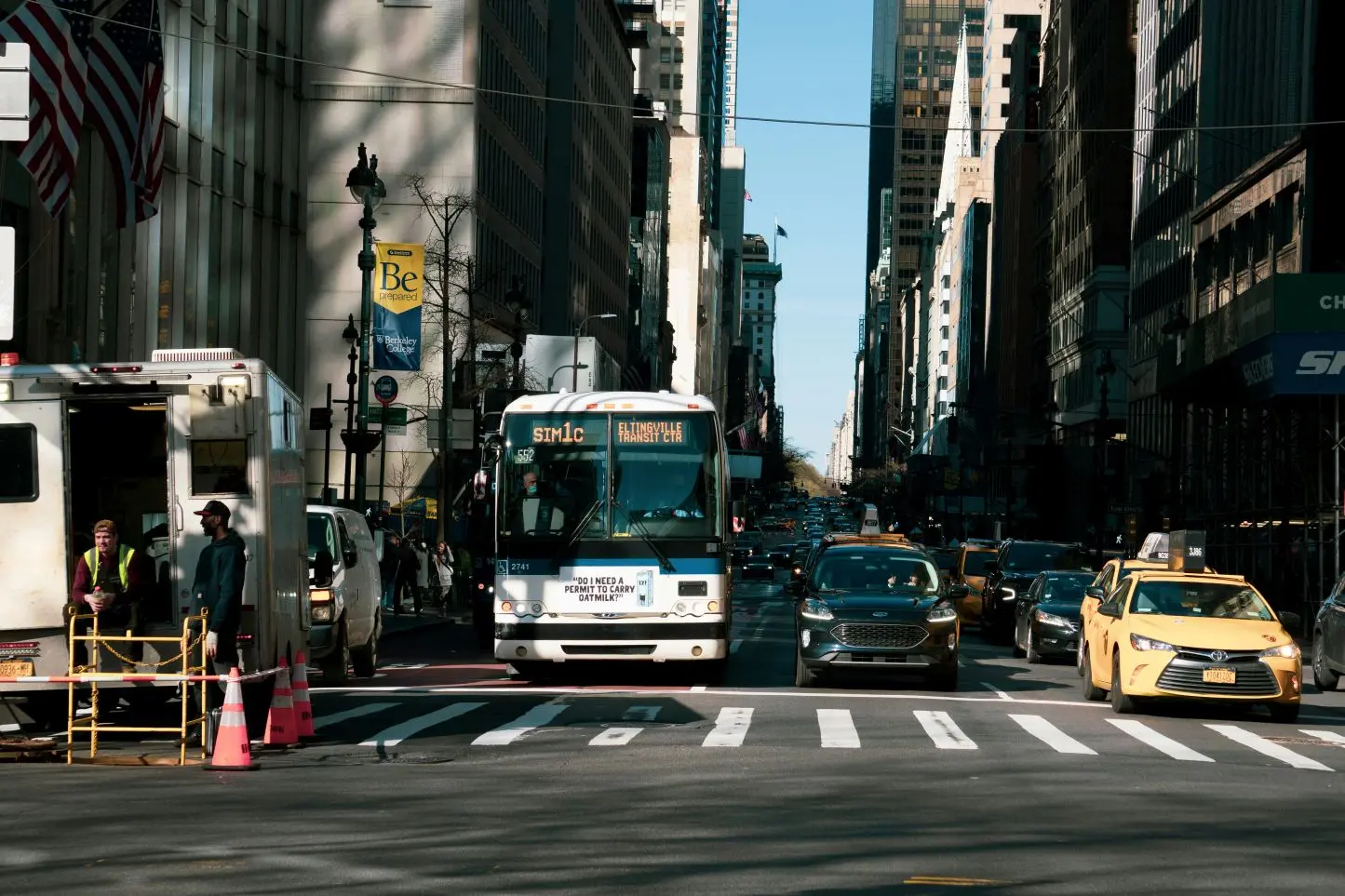
In 2025, New York mayoral candidate Zohran Mamdani pledged to deliver something never accomplished in a major U.S. city: citywide fare-free buses. Mamdani also included faster buses on his agenda—in a city long known for some of the slowest bus services in the nation.
Transit advocates praised the fast-and-free strategy as a bold affordability and equity measure.
Six months into Mamdani's administration, momentum has centered on faster buses. The city can improve bus speeds on its own, but eliminating fares requires a green light from the State of New York and the Metropolitan Transportation Authority (MTA).
Why Buses Matter
New York is unique for its low car ownership and heavy transit use, with 56% of residents relying on public transport. The MTA carries more than one million daily bus riders, making buses a critical part of the city’s mobility system.
The state government reported that an affordable public transport system in the city of New York remains a key factor in the cost of living. Transportation is too often a financial issue, representing 14% of household budgets. Residents need affordable and equitable bus services.
Transportation Alternatives, an advocacy group, argues that New York allocates street space inequitably, often favoring cars in communities most dependent on buses. Residents in lower income areas are 45% more likely to rely on buses than the city average, yet suffer from slower service. The group claims that dedicated bus lanes are more than a mobility upgrade. They are a much-needed equity intervention.
In marginalized communities, fast and affordable buses reduce financial hardship. “Only 14% of low-income housing units are located within a quarter-mile of a subway station, compared to 33% of market-rate units”—putting vulnerable populations at a structural disadvantage. For those without convenient subway access in the city’s outer boroughs, buses are the primary lifeline for accessing jobs, schools, and essential services.
A Reality Check
Because transit fare policy is controlled at the state and MTA level, Mamdani's fare-free vision encountered constraints beyond the mayor's control.
Delivering fare-free buses depends on “the financial capacity of the state and the political willingness of the governor,” said Robert Shapiro of Columbia University.
The New York city council and MTA leadership strongly resisted universal fare-free buses. Skeptics warned that starving the MTA of an estimated $750 million in annual fare revenue could degrade service or maintenance unless state and city governments offset the financial gap. Public transport ridership has not fully returned to pre-COVID levels, and fares already account for a smaller share of MTA operating revenue.
Scaling is another challenge. Can a major city scale a fare-free solution? While a few mid-sized U.S. cities—including Albuquerque and Kansas City—adopted fare-free bus systems, no transit network approaching New York's scale has eliminated bus fares citywide.
Boston and Los Angeles tested fare-free operations, and Mamdani cited a previous pilot in New York as evidence for expansion. The MTA reported ridership gains of about 30% on weekdays. Critics said the outcome was not worth the $15 million investment.
A Political Dilemma
When Mayor Mamdani faced opposition to his fare-free plan, he acknowledged that a citywide rollout would not happen in 2026.
City council leaders instead favor expanding the city’s Fair Fares program—a targeted subsidy for low-income riders—arguing that directing limited resources toward those with the greatest financial need is more fiscally sustainable while still addressing affordability.
The state legislature proposed pilot programs to test Mamdani's fare-free approach, but no funding agreement or state approval has emerged to move New York closer to a citywide fare-free network.
Separately, Governor Kathy Hochul and Mayor Mamdani backed a new tax on luxury second homes projected to raise about $500 million annually. While this action addresses broader fiscal pressures, it does not resolve the question of how a universal fare-free bus system would be funded.
Decisive Measures
Because fare-free operations require complex negotiations, the Mamdani administration moved swiftly on street-level changes controlled by the city:
The mayor acted decisively after taking office by hiring dedicated staff and:
- Expanding bus-priority infrastructure
- Reviving stalled bus projects
- Advancing corridor redesigns on heavily used routes
Elizabeth Adams, senior advisor for fast and free buses, is leveraging the city's power over street infrastructure to speed up city buses by 20% while applying pressure on the state for funding.
Mike Flynn, transport commissioner, announced the city will restart work on a busway project on Manhattan’s 34th Street—an iconic crosstown artery serving 28,000 daily bus riders.
“Too many New Yorkers spend too much time waiting on buses stuck in traffic. The 34th Street busway will change that, turning one of our most congested bus corridors into one that actually moves,” said Mamdani. The busway will improve street safety, support freight movement, and improve response times for emergency services.
Julia Kerson, deputy mayor for operations, emphasized that “faster buses and safer streets will not only ensure quicker commutes but will better connect neighborhoods, bringing real-life improvements to the entire area.”
A Path Forward
For now, Mayor Mamdani’s focus is on fast and safe buses while the future of fare-free buses is to be determined.
A dual approach—pursuing equitable fare relief while investing in service improvements—reflects political pragmatism. Faster, more reliable and safer bus services, combined with targeted subsidies, are less controversial but may deliver more immediate mobility benefits.
[Photo by Terrillo Walls on Unsplash]